
Your forklift was never designed for a 45-second loop.
It’s not necessarily a speed problem. A skilled operator can move quickly. The real issue is repetition. Find the load, line up, creep forward, make a correction, unload, and do it all over again. Every small delay adds up—and when the production line runs on tight cycle times, those seconds matter.
That’s where a transfer cart can make a difference.
But “transfer cart” is a broad category, and not all transfer carts work the same way. A rail guided vehicle (RGV) follows a fixed rail path, while an automatic guided vehicle (AGV) navigates without fixed rails.
So which one fits your factory?
Choosing between an RGV and an AGV comes down to more than the vehicle itself. Route layout, load capacity, power supply, control system, floor conditions, installation requirements, and long-term maintenance all pull the decision one way or the other — this guide takes them one at a time.
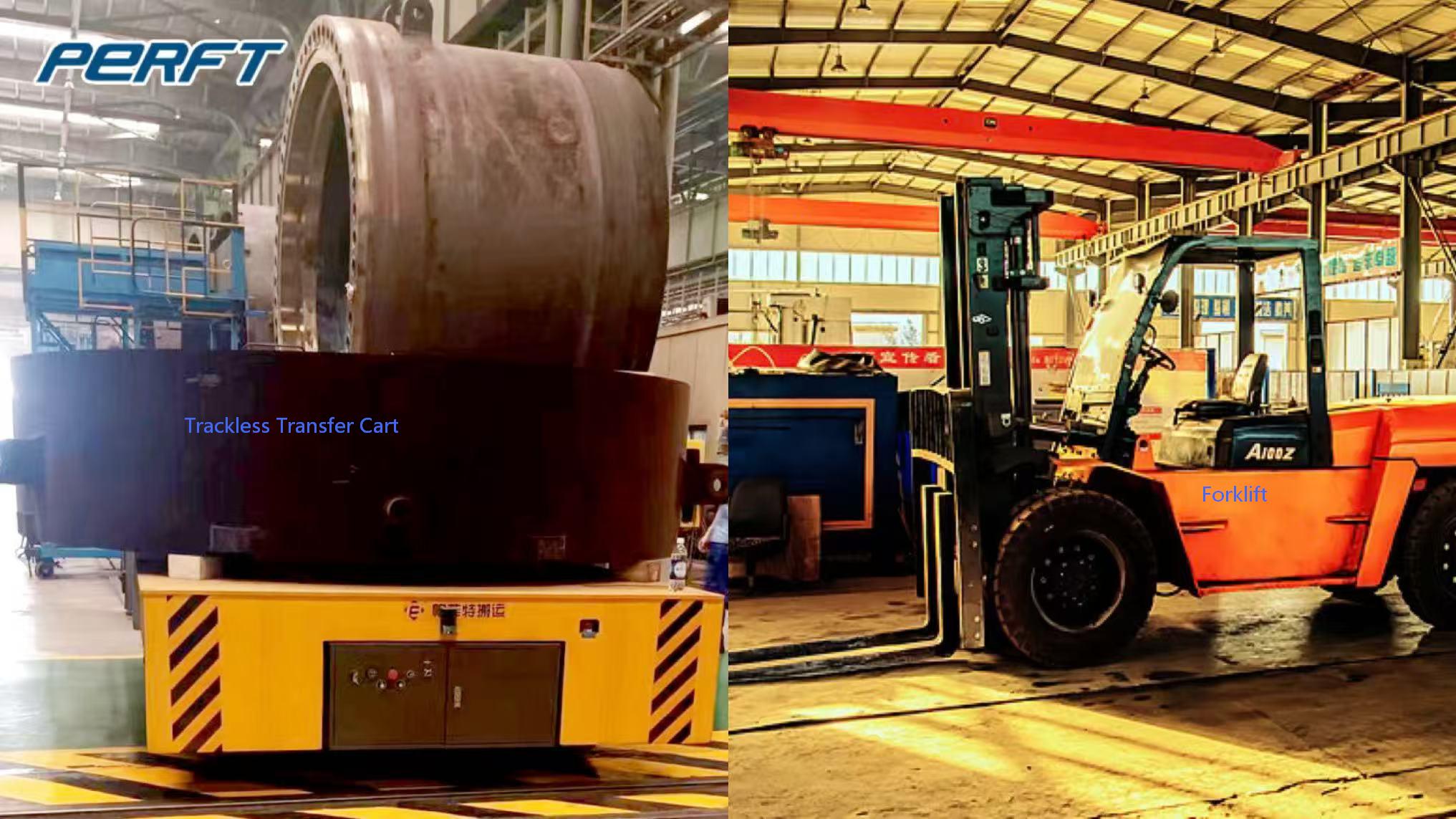
The first question isn’t “how much does it weigh?” It’s “will this route still be the same route in two years?”
If your material flow is locked in — a press cell, a fixed sequence of stations, a line that hasn’t moved since it was installed — a rail-guided cart is the cheaper and more repeatable option. The rail does the navigating. No map to argue with, no sensor to clean, no software update changing how the cart drives.
Answer that one question and half the decision is already made. Everything after it is sizing.
A rail guided vehicle does exactly what its name says: it rides steel rails laid on your floor. Flanged wheels lock it to the track. It can’t wander, because there’s nowhere to wander to.
What that buys you is repeatability. An absolute encoder tracks distance along the rail, and the VFD slows the cart as it nears the stop, then creeps it into place. On our RGV-5T, that works out to ±1mm repeat accuracy. A robot can reach in blind, because the cart is already where it’s supposed to be.
A cart that size runs at up to 120 m/min and is happy to keep that pace around the clock. Two details make it possible:
Power comes from the rail. A conductor rail runs the length of the track, and a carbon shoe on the cart slides along it. It’s the same contact system overhead cranes have used for decades. No battery, no charging station, no cable reel dragging on the floor. Three shifts run without a single stop for power.
The deck matches the job. Flat steel plate for pallets and skids, a roller deck if parts should roll straight onto the next line, reinforced plate if you’re stacking heavy blanks.
Press shops usually land here. Blank stacks move from the destacker to Press #2 every 45 seconds. The cart dwells for the cycle, then moves on the release signal from the press PLC. No operator, no walking, no radio call. The same setup handles appliance assembly, where refrigerator liners and drum shells advance station to station, and heat-treat exit lines, where steel wheels shrug off the heat that would melt rubber tires.
If your route never changes, an RGV is hard to beat. It’s simpler, cheaper to maintain, and it shows up in the same spot whether the lights are on or the floor is dusty.
An automatic guided vehicle is the flexible end of the family. No rails at all. Depending on the navigation package, it follows a laser-guided path, an electromagnetic track buried in the floor, or a magnetic strip. Change the layout, redraw the route, and the cart follows the new one.
Laser navigation usually wins the argument, because it needs no floor retrofit. No cutting concrete, no buried tape. Just a clean, level floor and a map in the controller.
That freedom costs hardware. The AGV carries its own obstacle detection, with infrared sensors or scanning radar, and stops itself when someone crosses its path. It also carries its own power. Lithium batteries cover a full shift or more, and a quick-swap battery set keeps a round-the-clock line moving without waiting out a charge cycle.
Load capacity is where AGVs go big. Our AGV series runs from 5 tons to 200 tons, with steel coil machines typically in the 30-to-50-ton range. Standard decks sit around 4000 × 2000 mm, though nobody should buy off that shelf if the coil dimensions say otherwise.
A recent example from a customer site: a steel mill runs a 50-ton AGV cart 16 hours a day, moving coils from the rolling mill to the finished-goods warehouse. Forklift labor costs dropped 60%, and the coil-dropping incidents that came with human error went away. That’s what the right machine does to a materials flow.
RGV or AGV, the sizing questions are the same: how heavy, how big, how often.
One rule of thumb: if the load can shift, the cart should hold it. A steel coil on a flat deck is an accident waiting to happen. The same coil on a coil holder is just cargo.
Most buyers leave this question until last, and it affects day-to-day operations more than any other spec.
Rail power is continuous by definition. The contact shoe rides the conductor rail for the whole length of travel, so “runtime” isn’t a concept that applies. Three shifts, five years, no charging downtime. The only wear part is the carbon shoe: ten minutes to swap, once a year, and it’s crane-standard hardware that any electrician recognizes. Predictable maintenance beats surprises.
Battery power exists for one reason: freedom from the rail. Lithium cells run quiet and clean indoors, no exhaust and no noise complaints. The question to ask yourself is whether your shift pattern fits a charge window. If it doesn’t, budget for a battery swap set or an automatic charging station up front. Nobody enjoys discovering that gap in month six.
The best cart on the market is dead weight if it can’t talk to your line.
On a fixed line, the RGV should plug into the press PLC over Profinet or Modbus with a simple handshake: request, in-position, fault. The PLC treats the cart like any other station. It asks for a cart, the cart arrives, the PLC confirms, work proceeds.
AGVs connect over the plant network the same way, with routes and task lists managed from the control system. If you run MES or a production management platform, have the supplier program the cart to slot into it. You don’t want a second remote sitting on a supervisor’s desk.
On rails, safety is mostly mechanical: end buffers at the ends of the track, hard-wired limit switches, and a safety scanner if the path crosses walkways. The cart stops. It doesn’t think about it.
On a trackless cart, safety is electronic: scanning radar, automatic stop, and optional warning lamps and audible alarms. The machine watches its surroundings and brakes itself.
Either way the rule is the same. The cart always yields to a person.
Think about who fixes the machine and what they already know.
Rail carts are simple underneath. Wheels, bearings, contact shoes, a gear reducer. Your crew has seen every one of these parts on a crane or a conveyor. The only electronics are the encoder and the drive, and those are well-trodden territory.
Battery carts add surface area: navigation sensors to keep clean, batteries to manage, charging hardware to maintain. None of it is hard, but there’s more of it. If your crew already looks after AGVs, no problem. If they don’t, the rail cart will be gentler on them.
What’s the real difference between an AGV and an RGV? An AGV navigates. An RGV rides rails. AGVs offer flexibility, but they need maps, sensors, and clean floors. An RGV just needs rails, and it shows up in the same spot whether the floor is dusty or the lights are off.
What happens when the conductor rail wears? The carbon shoe wears, not the rail. It’s a ten-minute swap once a year, and the parts are crane-standard. Dependably boring.
Can the cart integrate with our existing controls? Yes, on both types. RGVs use Profinet or Modbus handshakes with the line PLC. AGVs connect over the plant network, and we can program them to work with your MES or management platform.
Will a rail cart derail? Not if the rail is installed correctly. Flanged wheels guide it, and there’s nowhere else for it to go.
What floor does an AGV need? Level concrete or steel flooring, with no more than about 3 degrees of slope. If your floor can’t offer that, a rail system starts looking a lot more attractive.
For more questions, please come here.
Sketch your route, and send it over. Tell us the load, the part sizes, and the shift pattern, and we’ll size the drive, spec the rail or the battery, and tell you exactly what cycle you’ll get. You’ll have a layout drawing and a number within 24 business hours. No forty-page proposal. No fluff.