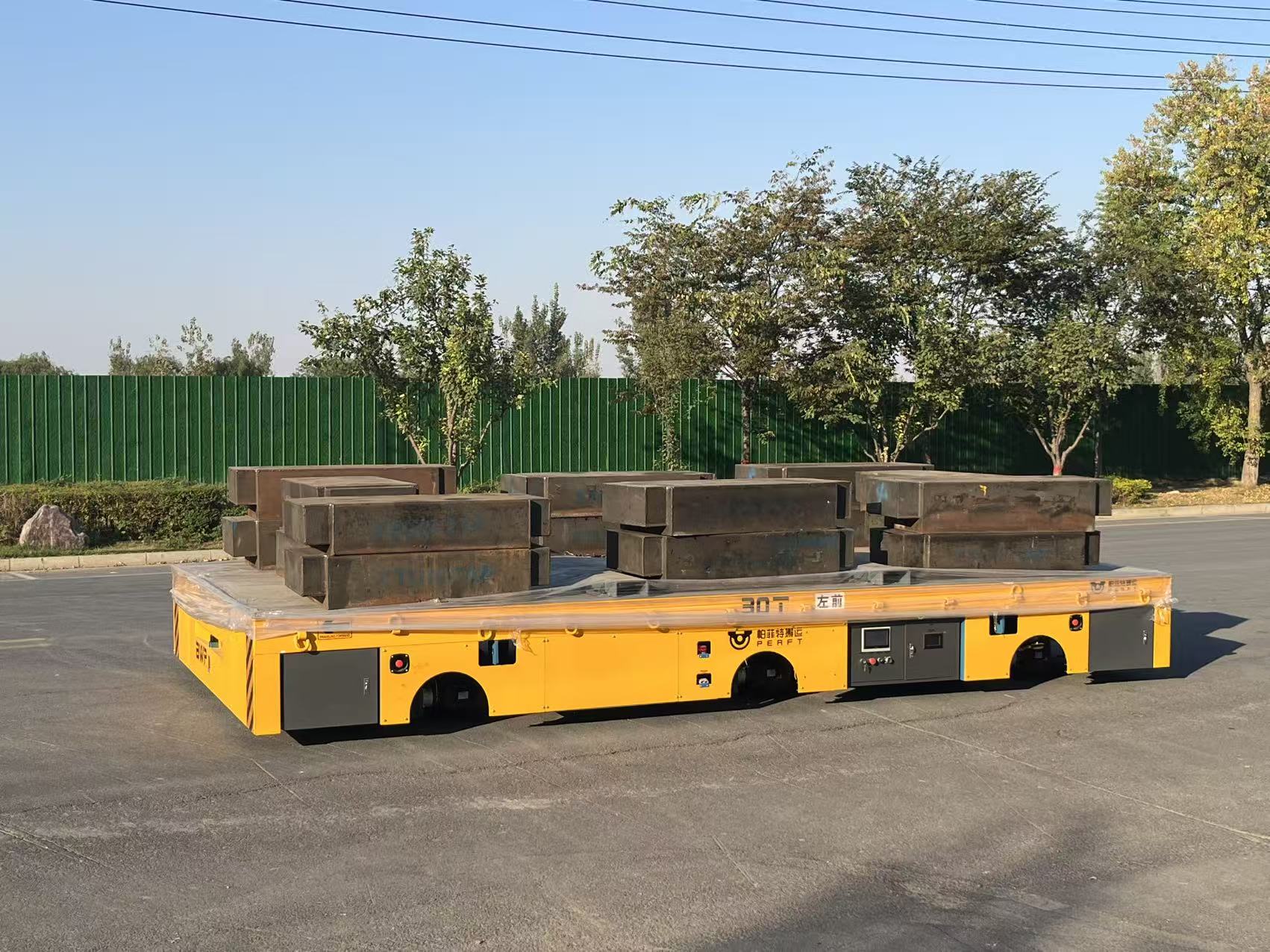
Anyone who has bought a heavy machine knows the gap between a spec sheet and a machine that actually carries its rated load, every shift, without the deck bowing or the brakes fading.So before this 30 ton longitudinal and transverse transfer cart left our workshop, we did what we always do: loaded the deck to full capacity and ran it. The video up top is that test — the same cart, the same route, loaded to its rated 30 tons. This is the run buyers usually ask to see before they sign off.
What we put on the deck
The load isn’t a tidy pallet. We stack 30 tons of steel on the flat platform the same way the customer’s own steel structures will sit — offset loads, long pieces, no perfect center of gravity. That’s deliberate. In a fabrication shop, a welded frame never lands dead-center; the cart has to carry the load the way real work loads it.
The low-profile deck is wide and flat, so the steel sits level and the overall height stays low. Lower load height means a lower center of gravity, which is exactly what keeps a 30-ton ride calm.
The test run, in order
The loaded cart doesn’t just drive forward once. We run it through the moves it will have to make on the customer’s floor:
- Longitudinal travel under full load. The cart leaves the stop, accelerates, and runs the main route with the full 30 tons on board. Watch how the deck sits — no visible sag, no shudder through the wheels.
- Soft starts and stops. A heavy load jerked around is how workpieces shift. On video the loaded cart pulls away gently and eases to a stop without the load rocking.
- The transverse shift. At the designated point the cart stops, switches direction sideways, and moves transversely to line up with the station route. This is the move a plain single-axis cart can’t do — one cart reaches multiple bays instead of one straight line.
- Positioning at the station. It stops where it’s supposed to, square and on the mark, so the next process picks the load up exactly where it expects it.
We run it loaded, we run it back, and we repeat. A one-time cruise at half load proves nothing.
What we’re watching while it runs
The camera shows the cart. Our engineers are looking past it:
- the deck staying flat under the full 30-ton weight;
- the drive pulling steadily, no strain or overheating under load;
- the brakes holding and the stop distance staying consistent, loaded vs empty;
- the wheels and axle sets taking the load evenly;
- the remote / pendant control responding the same way every run.
Anything that drifts in the loaded test gets fixed before the ship date. That’s the point of the test — the buyer’s floor is not the place to discover it.
Why this test matters to you
This is a factory acceptance run, not a marketing clip. When the cart arrives at a steel structure plant, a heavy machinery shop or a metal processing workshop, the customer repeats a version of it on their own track: load on, route run, stops checked. What we’re doing ahead of time is making sure that repeat test passes on the first day, with fitters and welders standing around watching.
A 30 ton transfer cart is a long-life machine. The loaded baseline established in this test is also the reference for years of later checks — how much stop distance changes, how the deck settles, how the electric drive ages.
FAQ
What is a transfer cart load test?
A full-capacity run before shipping: the deck is loaded to the cart’s rated capacity — 30 tons on this unit — and driven through its real routes, starts, stops and direction changes, to prove the machine carries its rated load safely.
How do you simulate a 30 ton load?
With stacked steel weight placed on the flat deck in the same offset, irregular way real workshop workpieces sit, rather than a perfectly centered test mass.
Do you test every cart before delivery?
Yes. The loaded run is part of the standard factory acceptance process; the video you see is a normal test build, not a one-off demo unit.
Can we witness the test or request a specific load?
Buyers are welcome to witness runs in person or on video call. If your own heaviest workpiece differs from 30 tons, tell us and we plan the test around your real load and your floor plan.
Is this cart rail-guided or trackless?
The movement scheme is planned around the customer’s layout — cross-laid track at intersections for longitudinal + transverse switching, or a trackless version if routes change often. We size the guidance to the building, not the other way around.
Watch the full test
The video on this page is the complete loaded run: 30 tons on the deck, longitudinal travel, the transverse shift, and the final stop at the station. Send us your floor plan and the weight of your heaviest steel component, and we’ll show you the test plan for your cart — before you buy, and again before it ships.
WeChat / WhatsApp / Tel: +86 15090325221