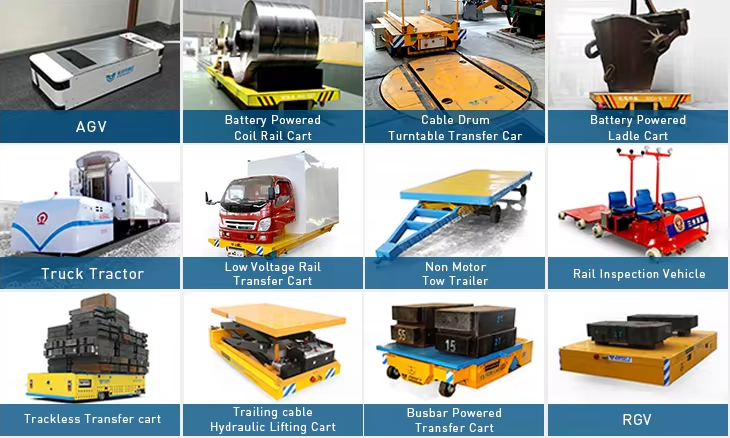
In the field of industrial material handling, when purchasing a motorized rail cart for sale, balancing precision, efficiency, and safety is crucial. To avoid costly mistakes and ensure long-term value with your motorized rail cart investment, here are the critical factors to prioritize, starting with load capacity and application scenarios.”
Calculate the maximum weight of the materials to be transported (e.g., 50-ton class for steel coil transportation, 100-ton class for heavy machinery handling).
Distinguish between “dynamic load” (weight during movement) and “static load” (weight when stationary) to prevent equipment overloading.
Prioritize motorized rail carts with high load capacity (50–200 tons) and high-temperature resistance (heat-resistant steel platform, thermal insulation components) to handle molten metal and heavy castings in 300–800℃ environments.
Focus on carts with ±5mm positioning precision (via laser sensors/servo drives) and automated integration (PLC/Ethernet compatibility) to align with robotic assembly lines and MES systems.
Emphasize maneuverability (small turning radius, flexible drives) and efficiency (3–5 km/h speed, quick-charging batteries) to navigate narrow aisles and speed up material turnover.
Comprehensively evaluate long-term energy costs (e.g., comparison between battery replacement costs and track power electricity costs).
Verify if the motorized rail cart for sale is compatible with existing track gauges (e.g., standard P38 rail or custom gauges).
For new track installations, consider track material (steel vs. composite) and durability.
Pay attention to structural designs such as robust steel frames, non-slip platforms, and safety railings.
Essential safety components: Emergency stop buttons, overload sensors, and collision avoidance systems.
Can the manufacturer modify the motorized rail cart for sale’s size, load capacity, or control system according to requirements? (e.g., adding remote operation functions for hazardous areas).
Ensure the equipment can adapt to growing production needs (e.g., upgrading from 50-ton to 100-ton load capacity).
Check certifications (e.g., ISO, BV Class certification) and industry experience (prioritize manufacturers with over 10 years of experience in heavy-duty equipment manufacturing).
At least 1-2 years of warranty for key components.
Focus on spare parts supply capacity, on-site maintenance services, and technical training support.
When buying a motorized rail cart, don’t just focus on the initial price—factor in maintenance, energy use, and downtime to avoid hidden costs.
-Maintenance: A cheap cart may need frequent repairs (e.g., worn wheels, faulty motors), while a high-end model with durable parts (heavy-duty frames, premium motors) costs less to maintain long-term.
-Energy Consumption: Inexpensive carts often use inefficient motors/batteries, leading to higher electricity bills. Premium models with energy-saving tech (e.g., regenerative braking) cut energy costs by 20–30% yearly.
-Downtime: A low-cost cart prone to breakdowns can halt production, causing lost output and delayed orders. A reliable high-end model, though pricier upfront, minimizes downtime and saves on long-term losses.
Purchasing a motorized rail cart for sale is a strategic decision. By prioritizing load capacity, power type, safety, and vendor reliability, you can select a solution that boosts productivity while minimizing risks. For personalized recommendations or a free cost-benefit analysis, [contact our expert team] (insert CTA link) to discuss your unique needs.