
Moving heavy stuff around a factory floor sounds simple enough until you actually try to do it efficiently. Forklifts work, but they chew up floor space and need licensed operators. Overhead cranes are great until your building has low ceilings or the load needs to go somewhere the crane boom can’t reach. That’s why a lot of plant managers end up looking at battery powered transfer carts — they’re not flashy, but they solve problems that other equipment can’t.
Here’s where battery powered transfer carts really earn their keep. Because the power source is onboard, there’s no cable trailing behind and no electrified rail to worry about. That sounds like a minor detail until you need the cart to navigate a track that isn’t a straight line.
Need a 90-degree turn between two production zones? An L-shaped track handles it. Got equipment in the way that forces a winding path? S-curves are no problem. Working around a circular blast booth or a curved assembly line? Arc tracks work fine. Even perpendicular track intersections — where one line crosses another — are manageable because there’s no cable to snag or reel to jam.
Compare that to a cable-reel cart, where every curve adds friction and wear on the cable, and where a tight enough turn can actually pull the cable off its spool. Or a low-voltage rail cart, which needs continuous electrified track and starts getting complicated on anything beyond basic straight runs. The battery approach just removes a whole category of headaches.
Sometimes transporting the load is only half the job — you also need to lift it. A lot of people don’t realize that battery powered transfer carts can be fitted with an onboard hydraulic lifting platform. The same battery that drives the motors powers a small hydraulic pump, so the whole system stays self-contained.
This matters in die handling, for example. A stamping press needs a new die, and the die weighs several tons. With a hydraulic lift cart, you roll the cart under the die, raise the platform to lift it off its storage stand, transport it to the press, and lower it into position — all without a crane or forklift getting involved. Same logic applies to mold changes in injection molding, or moving heavy equipment between different height workstations.
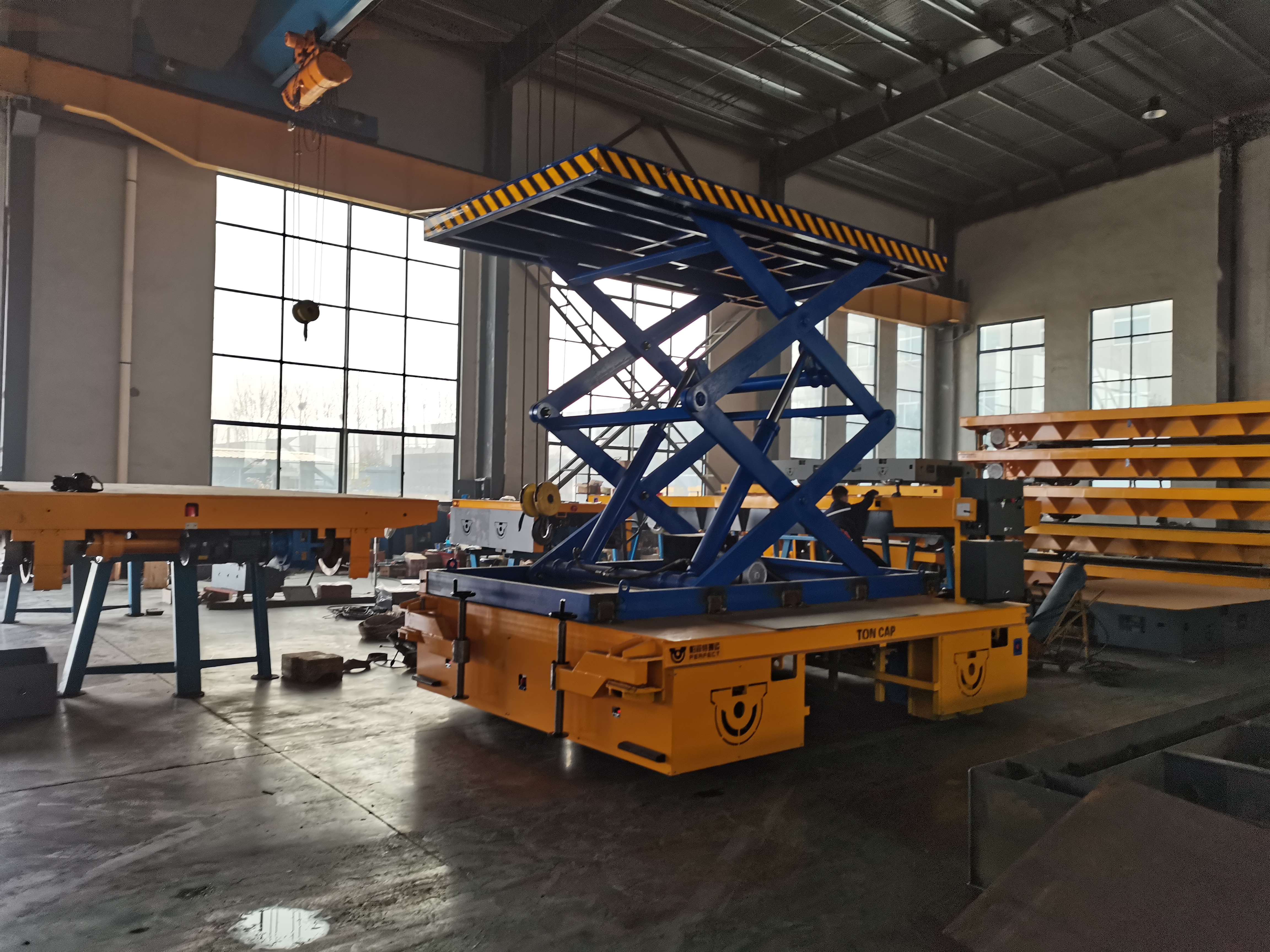
If you’re comparing transfer cart options, the three main categories are battery (BXC), cable reel (BJT), and low-voltage rail (BDG). Each has its place, but the trade-offs are worth understanding.
Cable reel carts are cheap to install because they run on standard track, but the cable is a constant maintenance item. It wears, it gets caught, it limits how far the cart can travel, and on curved tracks it’s a genuine headache. If your application is a simple straight shuttle under about 50 meters, they’re fine. Beyond that, the compromises add up.
Low-voltage rail carts eliminate the cable by electrifying the track itself, but that’s expensive. The rails need insulation, the installation is more complex, and the whole system is sensitive to water, dust, and debris on the track. They also don’t mix well with hazardous areas — an electrified rail in a flammable atmosphere is something most safety officers will reject immediately.
Battery powered transfer carts sidestep both sets of problems. Standard rails, no cable, no electrification, unlimited travel distance within the battery’s range, and they can be built for explosive environments. The trade-off is the battery itself — it needs maintenance and it needs to be recharged — but for a lot of facilities, that’s a much easier problem to live with than cable wear or electrified rail costs.
After all the technical discussion, it comes down to this: battery powered transfer carts are the best fit when your operation has any of these characteristics:
Steel mills, precast concrete yards, automotive plants, shipyards, chemical facilities, and heavy machinery manufacturers are all common users. But really, any operation that moves heavy loads over a defined path — and wants to do it without the limitations of cables or electrified track — is a candidate.
At the end of the day, battery powered transfer carts aren’t the newest or most glamorous piece of material handling equipment. What they are is dependable. They carry their own power, they run on cheap standard track, they navigate complex layouts, they can be built for hazardous areas, and their DC motors deliver the kind of smooth, torquey performance that heavy loads demand.
The battery requires attention — there’s no getting around that — but for most facilities, that’s a small price to pay for the flexibility and low infrastructure cost these carts offer. If you’ve been struggling with forklift congestion, crane limitations, or the maintenance headaches of cable-powered carts, it’s worth taking a serious look at what a battery powered transfer cart can do for your operation. Just make sure you work with a manufacturer who’ll actually customize the cart to your load, your track, and your environment — not just sell you a standard model off a shelf.