
In many workshops, the forklift is the default answer to “how do we move heavy stuff?” But when your loads follow a fixed, repeatable route — between machining stations, assembly lines, or storage bays — a 5 ton rail transfer cart does the job better: larger single-trip capacity, precise positioning, zero emissions, gentler load handling, and operating costs far below a forklift. Here is when and why you should make the switch.
A rail transfer cart (also called a rail-mounted transfer cart or rail cart) is a battery-powered, rail-guided material handling vehicle that runs on a fixed track installed on the workshop floor. The 5-ton model offers:
Because the route is physically defined by the rail, the cart returns to the same position trip after trip — no operator steering required.
Where Forklifts Fall Short on Fixed Routes Forklifts shine at flexible, ad-hoc picking. But on fixed, high-volume transfer routes, four weaknesses show up:
1.Limited single-trip capacity— a forklift carries one pallet or load per trip, so moving several tons between stations means many trips and constant back-and-forth driving.
2.Operator-dependent accuracy— the path varies with driver skill and attention, so positioning is approximate.
3.Exhaust and noise in enclosed workshops— fuel exhaust and engine noise are a poor fit for clean production areas.
4.Higher running costs— fuel, frequent maintenance, specialized operator training, and supervision expenses accumulate over long production runs.
1.More material per trip.Rated for 5 tons, the cart moves a full load in one run, cutting trips dramatically and raising material turnover efficiency.
2.Precise, repeatable positioning.Guided by the rail, it follows a stable route without drifting and stops at the same position every cycle.
3.Zero emissions, low noise.Pure electric drive means no exhaust and quiet operation — ideal for enclosed workshops and green-factory requirements.
4.Gentle load handling.Soft start and stop protect workpieces from shaking and impact, reducing damage risk.
5.Far lower operating costs.Battery power plus simple maintenance keeps running costs well below forklift operations over time.
6.Simple to operate.Ordinary workers become productive after brief training — no years of forklift experience needed.
7.High reliability.Once the track is installed, the cart runs reliably on its fixed route with a low failure rate.
8.Ramp capability.Under full load, a 5-ton rail transfer cart handles ramp sections without slipping.
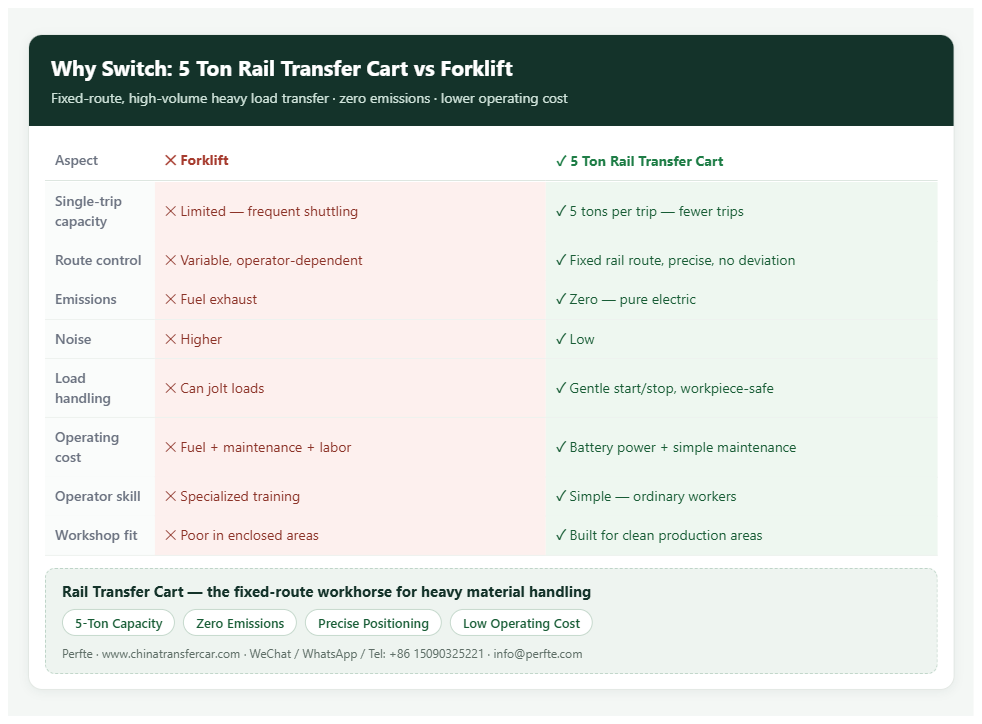
|
Aspect |
Forklift |
5 Ton Rail Transfer Cart |
|
Single-trip capacity |
Limited — frequent shuttling |
5 tons per trip — fewer trips |
|
Route control |
Variable, operator-dependent |
Fixed rail route, precise positioning, no deviation |
|
Emissions |
Fuel exhaust |
Zero — pure electric |
|
Noise |
Higher |
Low |
|
Load handling |
Can jolt loads |
Gentle start/stop, workpiece-safe |
|
Operating cost |
Fuel + maintenance + labor |
Battery power + simple maintenance |
|
Operator skill |
Specialized training |
Simple training |
|
Enclosed workshop fit |
Poor |
Built for clean production areas |
A rail transfer cart is not a forklift replacement for every job. Keep the forklift when you need:
For high-frequency, fixed-route, bulk material flow — typical in battery plants, steel fabrication, casting, and assembly workshops — the rail transfer cart wins on capacity, precision, cost, and cleanliness.
Proven in Battery Production A real-world example: a lithium battery manufacturer in Jiaozuo replaced forklift shuttling with a 5-ton transfer cart on its production line and reported noticeably higher efficiency, stable heavy-load running, gentle start-stop, a low failure rate, and operating costs far below a forklift.
Read the full case study:https://www.chinatransfercar.com/electric-transfer-cart.html
Q1. Is a rail transfer cart faster than a forklift? On fixed routes, the efficiency gain comes from moving more material per trip with precise, repeatable positioning — not from chasing top speed. Operating speed can be configured for your process; contact us for specifications.
Q2. What can a 5 ton rail transfer cart carry? Up to 5 tons of workpieces, battery assemblies, molds, and other heavy items on its 2,300 × 1,300 × 500 mm platform.
Q3. Does a rail transfer cart require track installation? Yes. A fixed rail is installed on the workshop floor along the transfer route; after installation the cart follows the route with no deviation and a low failure rate.
Q4. Can rail transfer carts climb slopes? Yes — under full load, the 5-ton cart handles ramp sections without slipping.
Q5. How much does a rail transfer cart cost to run? Running on rechargeable battery power with simple maintenance, its operating cost is far lower than a forklift over the same duty cycle.
Q6. Rail transfer cart or trackless transfer cart — which is right for me? If your route is permanent and repeatable, a rail cart gives maximum route stability. If you need routing flexibility in high-mix production, a trackless (guided) transfer cart is a better fit. Tell us your layout and we will recommend the right type.
Q7. How do I get a quote? Contact us on WeChat or WhatsApp at +86 15090325221, email info@perfte.com, or visit www.chinatransfercar.com.
Ready to Replace Forklift Shuttling with a 5 Ton Rail Transfer Cart? Talk to Perfte today. We will confirm capacity, platform size, power supply, and control options for your application.